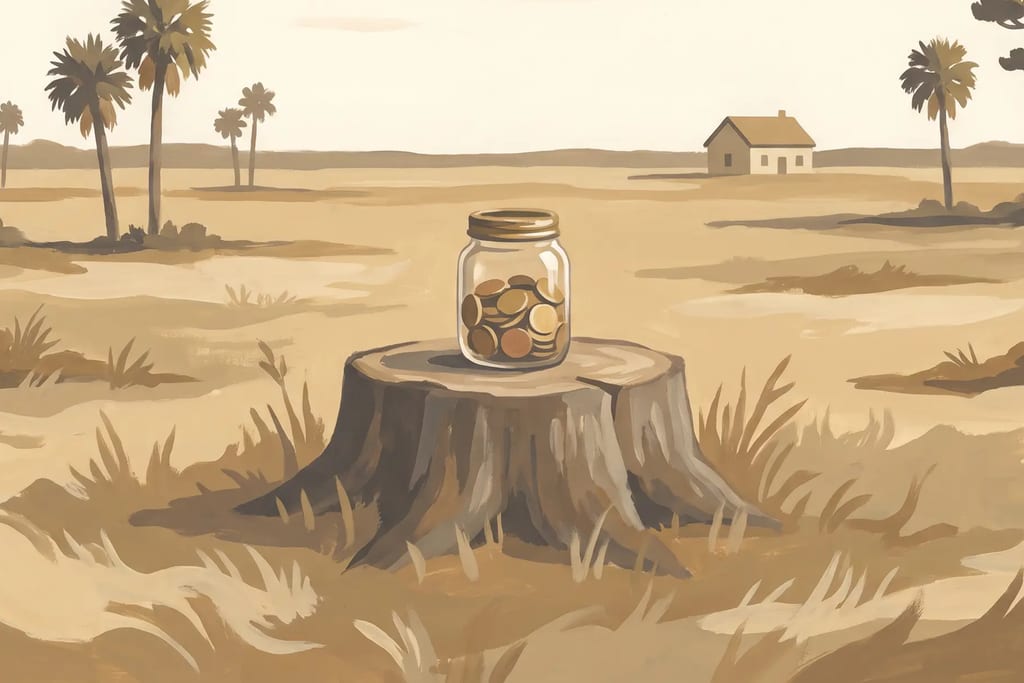

There is an old proverb, said to come from Norway, that measures a life in a strange chain of comparisons. A fence lasts three years. A dog lasts three fences. A horse lasts three dogs. And a man lasts three horses. Work the arithmetic and you arrive at eighty one years. It is folk wisdom rather than Scripture, but it sits surprisingly close to something the Bible said long before anyone counted fence posts. Our years are countable. They are shorter than we behave as though they are. And the Bible treats that fact not as a reason for gloom but as the beginning of wisdom.
Seventy Years and a Sigh
Psalm 90 sets God and us side by side and refuses to soften the difference. It opens with permanence: “Lord, you have been our dwelling place in all generations” (). Before the mountains existed, before the earth was formed, God already was, “from everlasting to everlasting” (). Then the psalm turns to us. Our days are like grass that springs up in the morning and is cut down by evening. “The days of our life are seventy years, and if by reason of strength eighty years,” yet even those years are marked by labor and sorrow, “for it is soon cut off, and we fly away” ().
The honest response to that is not despair. The psalm itself tells us what to do with the information: “Teach us to number our days, that we may gain a heart of wisdom” (). Numbering days is simply learning what you are working with and planning accordingly. Consider that one percent of a single day is fourteen minutes and twenty one seconds. That is all. Fourteen minutes with an open Bible is one percent of your day spent on the only thing you will carry past it. Most of us have never thought about our time in percentages, and it is a clarifying exercise.
The Mist Nobody Plans For
James writes to people making confident plans. They intend to travel to a certain city, spend a year there, do business, and turn a profit. His objection is not ambition. It is amnesia. “Whereas you do not know what will happen tomorrow. For what is your life? It is even a vapor that appears for a little time and then vanishes away” (). Some translations call it a mist. The right posture, James says, is to speak differently: “If the Lord wills, we shall live and do this or that” ().
Jesus told a story with the same shape. A prosperous man decided to tear down his barns, build bigger ones, and finally take his ease. God’s answer was one sentence long: “Fool, this night your soul will be required of you” (). He was not condemned for planning. He was exposed for assuming. Very few people in Scripture were ever told the day they would die, and we are not among them.
This Is the Day
If tomorrow is uncertain, today becomes valuable rather than ordinary. “This is the day the Lord has made. Let us rejoice and be glad in it” (). Notice that it is a command with no conditions attached. It does not wait for the day to go well, or for the person reading it to be a morning person. Whatever yesterday held, a new morning is a gift handed over freely.
It is also worth noticing where that verse sits. Just two verses earlier the psalm says, “The stone which the builders rejected has become the chief cornerstone” (). The rejoicing is anchored in Christ, the very one who would be rejected, mocked, crowned with thorns, and crucified, and who is nonetheless the cornerstone of God’s kingdom. The gladness of an ordinary Tuesday rests on something far larger than the weather.
Walking Carefully With What Is Left
Paul puts the matter in practical terms. “See then that you walk circumspectly, not as fools but as wise, redeeming the time, because the days are evil. Therefore do not be unwise, but understand what the will of the Lord is” (). Circumspectly is an old word that simply means carefully. Wisdom here is not the same thing as information. Wisdom is knowing what to do with what you already know.
Paul then contrasts two ways of spending the same hours. One is to be filled with wine and its excess. The other is to be filled with the Spirit, “speaking to one another in psalms and hymns and spiritual songs, singing and making melody in your heart to the Lord” (). Two people can spend an identical Sunday and end it in completely different places. Time is not neutral. It is always being spent on something.
Neither Gloomy Nor Giddy
There is a temptation to let this kind of thinking make us grim. There is an equal temptation to go the other direction and become so relentlessly upbeat that nothing serious ever gets said. Neither one is faithful. Believers can be warm and glad in how they speak while remaining immovable in what they teach. Doctrine cannot be conceded a single inch, but delivery can and should be kind.
That distinction matters when people suggest that all religious paths lead to the same place, sometimes borrowing Jesus’ own words about the vine to make the case. Read carefully, though, He said, “I am the vine, you are the branches” (). The branches are individual people bearing fruit, not competing systems of teaching. Standing firm on that is not unkindness. It is the reason we bother to speak at all, and how we say it either builds someone up or quietly pushes them away.
Still Enough to Trust
Numbering days does not mean living in a rush. “God is our refuge and strength, a very present help in trouble. Therefore we will not fear, even though the earth be removed” (). The same psalm that describes nations raging and mountains falling into the sea contains the instruction, “Be still, and know that I am God” (). Busyness and faithfulness are not the same thing. Some of the best use of a short life is a deliberate pause to remember who is actually holding it.
Now Is the Part We Have
Paul writes that we should “know the time,” that “it is high time to awake out of sleep,” because the night is far spent and the day is at hand (). Cast off the works of darkness. Put on the armor of light. Walk properly. All of that is present tense. Scripture never describes the Christian life as something to begin later, once things settle down, and its own pattern for coming to Christ is a matter of hearing, believing, repenting, and being baptized for the forgiveness of sins ().
Yesterday is finished. Tomorrow is not promised. Today is the one piece of time we have actually been handed, and it is enough to do something faithful with. So fix your eyes on Jesus, the author and perfecter of our faith (), and spend the hours in front of you like they matter. They do.