Sometimes the most meaningful transformation in life begins quietly. No spotlight, no announcement—just ordinary decisions made with a heart that quietly belongs to God. Genesis 24 introduces us to Rebekah in one such ordinary moment: a young woman going out to draw water. Yet in her simple act of service, Scripture reveals a depth of character shaped by reverence, kindness, and courage.
Rebekah was not chosen because of status, wealth, or appearance. She was noticed because of the kind of person she already was—steady, hospitable, compassionate, and attentive to the needs around her. Her story gives us a picture of what faithful living looks like when no one else is watching.
Guarding the Heart in an Age of Distracted Living
One of the first things Scripture highlights about Rebekah is that she was not part of the idolatrous culture surrounding Abraham’s family. That detail feels ancient, yet the principle remains incredibly current. Idolatry is not limited to carved statues; it’s anything that claims the devotion of our hearts at the expense of God.
Today, idols often look like:
- endless scrolling on a screen
- constant comparison
- entertainment that consumes our time and affections
- a fixation on image, success, or approval
Idols promise fulfillment but deliver distraction. They slowly pull our attention away from God until our spiritual senses grow dull.
Rebekah’s example reminds us that holiness still matters—not perfection, but a heart intentionally oriented toward God. Guarding our hearts today might look like setting healthier boundaries with media, creating space for Scripture, or simply becoming more aware of what shapes our desires.
The Beauty of a Compassionate Spirit
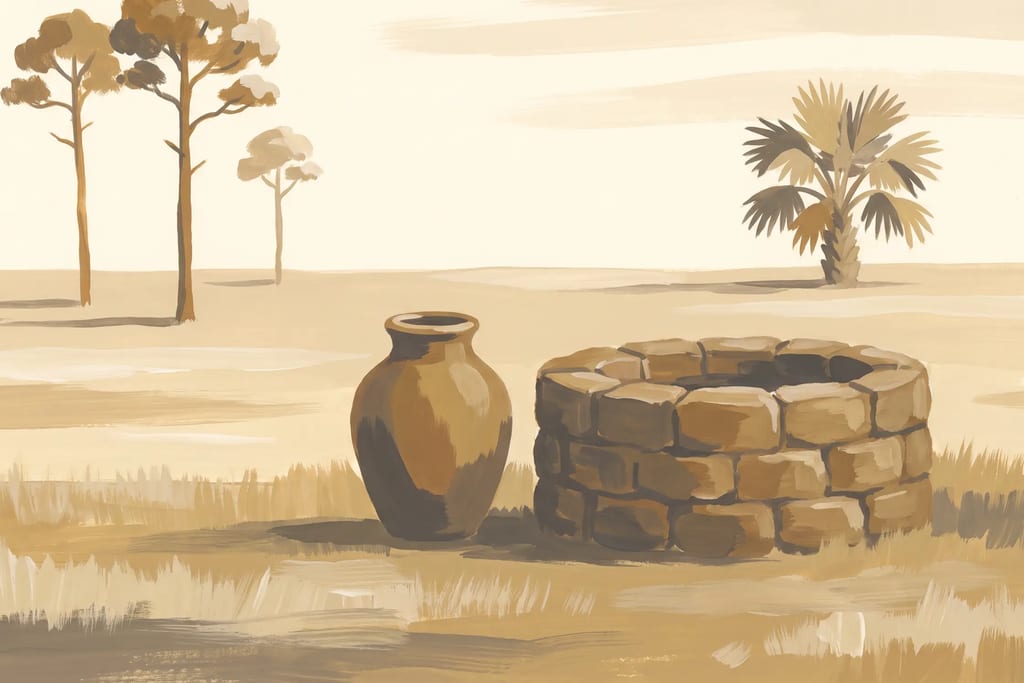
The servant who met Rebekah had prayed for guidance, and the answer came through her kindness. What stands out is not merely that she offered water to a weary traveler, but that she went beyond the expected. She relieved his thirst, then tended to the needs of his camels—an act that required real effort and time.
Compassion that costs us something is the kind of compassion that reflects God’s heart.
Rebekah saw a need and responded with tenderness, respect, and initiative. Her compassion was not rushed or selective. It wasn’t reserved only for people who could benefit her. It flowed naturally from her character.
We live in a world that moves quickly and rewards self-focus. Kindness can feel like an interruption. But Scripture invites us to rediscover the beauty of slowing down long enough to see others—truly see them—and respond with patience and grace.
Hospitality as a Way of Life
Hospitality in the Bible is far deeper than entertaining guests. It is a posture of welcome, a willingness to create space for others. Rebekah didn’t only offer water; she opened her home. She extended generosity without hesitation or suspicion.
Romans 12 calls Christians to be “given to hospitality”—a description of people who run toward opportunities to bless others, not away from them.
Hospitality is less about the size of our home and more about the size of our heart. It is expressed in listening well, in opening our lives, in choosing presence over convenience. When we welcome others, we reflect the heart of God, who continually welcomes us with patience and love.
Trusting God’s Quiet Providence
Genesis 24 also shows the quiet but unmistakable hand of God weaving events together. Through prayer, trust, and obedience, the servant was led to the right family, at the right moment, through the right person.
Providence does not mean God forces our choices; Scripture emphasizes our free will and responsibility. Instead, providence means God works within our decisions, prayers, and circumstances to accomplish His will. He opens doors, shapes opportunities, and places people in our path.
Much of God’s work in our lives will look like this—subtle, quiet, and only fully understood in hindsight. Rebekah’s story reassures us that when we live with a heart tuned toward God, He guides our steps even when we cannot yet see the bigger picture.
Courage to Step Into the Unknown
Perhaps the most striking moment in Rebekah’s story is her willingness to step into a future she had not seen. She agreed to leave her home, travel a great distance, and enter a new chapter God had prepared for her. She was not passive—she chose courage.
Faith often requires us to take steps before we see the outcome. Not recklessly, but prayerfully, with trust in the One who calls us forward. Rebekah’s courage challenges us to do the same: to trust God enough to move when He opens a door, even when the journey feels uncertain.
The Quiet Strength of Inner Beauty
Before meeting Isaac, Rebekah veiled herself—a simple gesture of modesty and humility. Scripture is not elevating a cultural dress code but revealing something deeper: a heart that values inner character over outward display.
We live in a culture saturated with image. Appearance is promoted, curated, filtered, and measured. Yet Scripture points us repeatedly to the beauty of a gentle and quiet spirit ()—not silence, but calm strength rooted in God.
Inner beauty grows from:
- humility
- spiritual depth
- kindness
- self-control
- a heart aligned with God
Rebekah’s modesty and dignity reflect a timeless truth: our worth is defined by God, not by outward appearance or cultural pressure.
A Life Shaped by Meditation and Reflection
Isaac enters the story as a man meditating in the field—quietly reflecting, preparing his heart, and seeking God. In a world of noise, distraction, and hurry, his example reminds us how vital reflection is for spiritual stability.
We need stillness to hear God’s voice. We need space to discern His will. We need moments to let Scripture shape our thinking and renew our minds.
Transformation begins in the inner life—long before it becomes visible in the outer life.
Shining as Lights in a Confusing World
Rebekah and Isaac lived in a world surrounded by idolatry, moral confusion, and spiritual inconsistency. Yet their lives show what it looks like to follow God wholeheartedly in the midst of a culture moving the opposite direction.
The same calling is ours today. We cannot control the moral direction of the world, but we can choose how we live within it. We can be people of kindness, hospitality, courage, purity, meditation, and inner strength. We can choose to cultivate character that reflects Christ.
Rebekah’s story invites us to ask a simple question:
Who am I becoming when no one else sees?
Because often, it is in the quiet places—drawing water, offering kindness, making daily choices—that God shapes us into people who shine His light most clearly.