One of the most sobering stories Jesus ever told is found in Luke 16. It’s not frightening because of flames or torment, but because it exposes something far more subtle and dangerous: a heart that becomes blind.
Blind to suffering.
Blind to need.
Blind to responsibility.
Blind to eternity.
Learning to See What God Sees
In the account of the rich man and Lazarus, Jesus paints a contrast between two lives that couldn’t have been more different. One man dressed in luxury, feasted daily, and enjoyed every comfort. The other was laid outside his gate—hungry, hurting, and unnoticed. The rich man did nothing cruel to Lazarus; he did something far worse in the eyes of God: he did nothing at all.
It’s easy to distance ourselves from the story, but the truth is uncomfortably familiar. Wealth is not the issue; many faithful people in Scripture were blessed materially. The danger arises when abundance numbs us, convincing us that our blessings exist only for our enjoyment, not for service.
Jesus invites us to see beyond possessions—to look through God’s eyes at the people right in front of us.
The Quiet Temptation of Greed
Most of us don’t think of ourselves as greedy. We imagine greed as something loud and obvious—boardrooms, scandals, and secret bank accounts. But in Scripture, greed is rarely dramatic. It’s subtle. Quiet. Respectable.
It shows up when we cling too tightly.
When we stop noticing needs around us.
When giving becomes an afterthought instead of a lifestyle.
When “later” becomes our favorite excuse.
In Luke 16, Jesus presents greed not as a financial issue but a spiritual posture—a way of living that closes itself off from compassion. The rich man didn’t harm Lazarus; he simply stepped over him. Day after day. Meal after meal. Opportunity after opportunity.
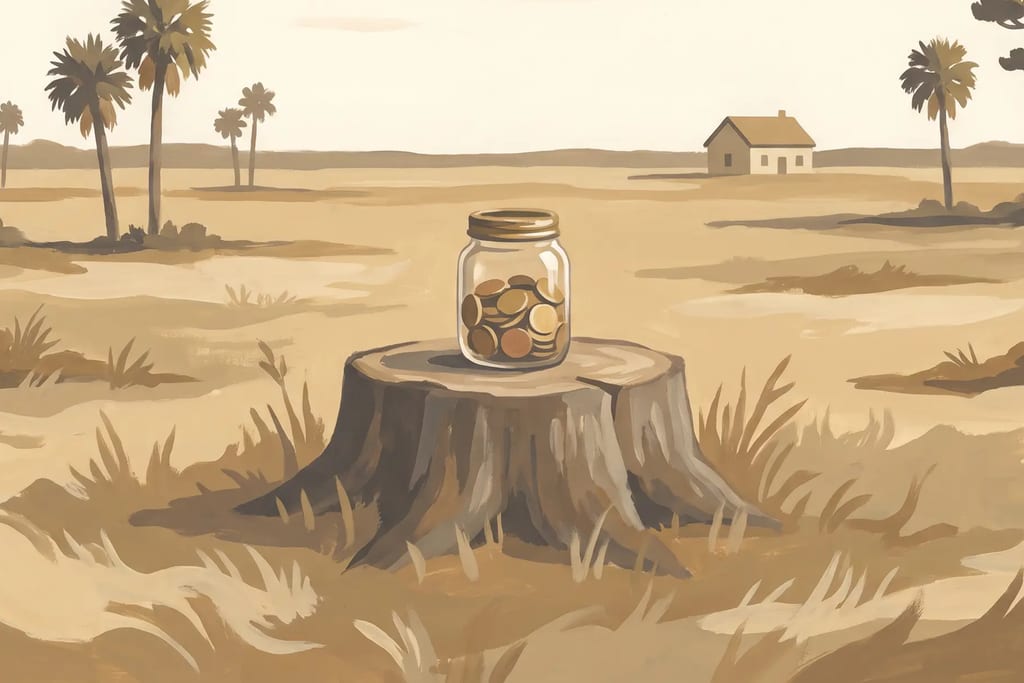
Greed is not measured by what we have but by what we withhold.
Scripture repeatedly warns us of this danger:
- “It is more blessed to give than to receive.” ()
- “Let us do good to all people, especially to those of the household of faith.” ()
- “Be rich in good works, generous and ready to share.” ()
God doesn’t condemn wealth—it is often a blessing from His hand. But He calls us to hold it loosely, aware that everything we have is entrusted to us for His purposes.
The Dash Between Two Dates
If you’ve ever walked through a cemetery, you’ve seen it: a person’s entire life represented by a small horizontal line between the year of birth and the year of death. The dash is easy to overlook, but it carries the weight of eternity.
The dash is where we decide whether we will love God or ourselves.
Whether we will open our hands or close them.
Whether we will see people the way Jesus sees them.
The rich man’s problem wasn’t his wealth; it was what he did—or didn’t do—during his dash. Lazarus, though poor and hurting, lived faithfully and ultimately found comfort in God’s presence.
The question is not how much or how little we possess. The question is: What are we doing with what God has placed in our hands during our short time on earth?
The Reality of Life Beyond This One
While Jesus’ main emphasis in the story isn’t meant to satisfy curiosity about the afterlife, He does reveal several truths that deserve our attention. These truths are simple, consistent with Scripture, and meant to shape how we live now.
1. Death is not the end.
Both men continued to exist after death. Consciousness, awareness, and identity remained. We do not fade into nothing; we return to God who gave us life ().
2. Our identity and memory continue.
The rich man remembered his life, his choices, even his family. Eternity does not erase who we are—it reveals who we truly were.
3. There is a separation between the righteous and the unrighteous.
Scripture teaches that God is just. Life may seem unfair, but eternity will not be. A great divide exists, not out of cruelty, but out of perfect righteousness.
4. Eternity is fixed.
The rich man could not return and change his choices. The time to respond to God is now, not later. “Later” is not promised.
These truths are not meant to scare us but to awaken us. They remind us that what we value today shapes our forever.
The Quiet Power of God’s Word
One of the most striking elements in the story is Abraham’s response to the rich man’s plea for a miraculous warning to his brothers.
“They have Moses and the Prophets; let them hear them.”
In other words:
The Scriptures are enough.
If a person will not listen to God’s Word, even a miracle will not move them.
This truth remains vital today. God does not leave us guessing. He has given us everything we need for life and godliness (). His Word teaches, corrects, equips, transforms (). It is not outdated or insufficient; it is living, active, and complete.
The problem is not that God failed to speak.
The problem is that we often fail to listen.
If we desire hearts sensitive to God, open to others, and detached from greed, the path is simple: we must return to Scripture—not to check a box, but to be shaped by it.
Living With Open Hands
The rich man’s tragedy was not what he possessed, but what he refused to give. Lazarus’ blessing was not found in wealth, but in trusting God despite hardship.
Every follower of Jesus is called to live with open hands:
- open to sharing
- open to serving
- open to seeing the overlooked
- open to stepping into someone else’s need
A generous life is not measured by bank statements—it is measured by compassion, humility, and faith.
When we loosen our grip on earthly wealth, we strengthen our hold on eternal treasure.
What God Sees When He Looks at Us
Jesus’ story is not meant to condemn—it is meant to awaken. It invites us to examine our priorities with honesty, courage, and hope.
The question is not whether we are wealthy or poor by worldly standards. The question is whether we are becoming people who reflect the heart of Christ.
People who see those sitting at our gate.
People who use what we have for the good of others.
People whose lives point to a better kingdom.
Because in the end, what matters most is not how much we collected, but how much we gave. Not what we earned, but what we offered. Not what we kept, but who we became.
The dash is brief.
The impact can be eternal.
And God sees it all.